
Asagaya Jazz Streets 2026
October 30 and 31, 2026
Even on an off day, Asagaya is one of Tokyo's coolest neighborhoods. A mix of old-school shitamachi vibes, urban renewal, hipster clubs, and family-friendly livability, Asagaya always feels welcoming. But during the Asagaya Jazz Streets held every October for the past 30 years, it really comes alive as the site of a large and spectacular two days of jazz. With over 200 acts at ten public venues, ten street stages, and 33 participating clubs, restaurants, and cafes, it’s an amazing amount of music. Add in the musicians on street corners, at station exits, and walking in parades, and the experience bursts out of the pages of the 28-page guide.
The Asagaya Jazz Streets Festival is now in its 31st year, and the word is out. Each venue I went to was full. Even the backstreets and venues farther from the station were packed. At some places, the numerous volunteers in vibrant orange windbreakers were left to apologize to those arriving too late to get a seat, even in 200-person auditoriums. Most jazz groups would be thrilled to have such a large audience on a regular night.
I was pleased with what I got to hear, intentional and accidental, but what did I miss? Nearly 20 other venues had jazz at the same time—an extravagance of choice! I was struck with FOMO anxiety! I skipped one or two encores just to get to another event and hear a few tunes from another group. Wherever I moved, I always seemed to be in the right place. I could write another article about all the fantastic shows I had to miss.
I first dropped in to hear Makiyo Sakai’s Special Quartet. Even in a large room on the second floor of a residents’ center (with offices at work on the first floor), nearly every seat was taken. I slid into a back seat. With a band featuring pianist Shinji Akita, bassist Ryoji Orihara, and the always amazing Hidenobu Kalta Otsuki on drums, you can’t go wrong. But Sakai’s special talent is to blend her stellar flute-playing with the sounds of the other band members. She layers the whispering delicacy of flute on top of the gravelly, tougher sounds of the rhythm section. It fit perfectly.
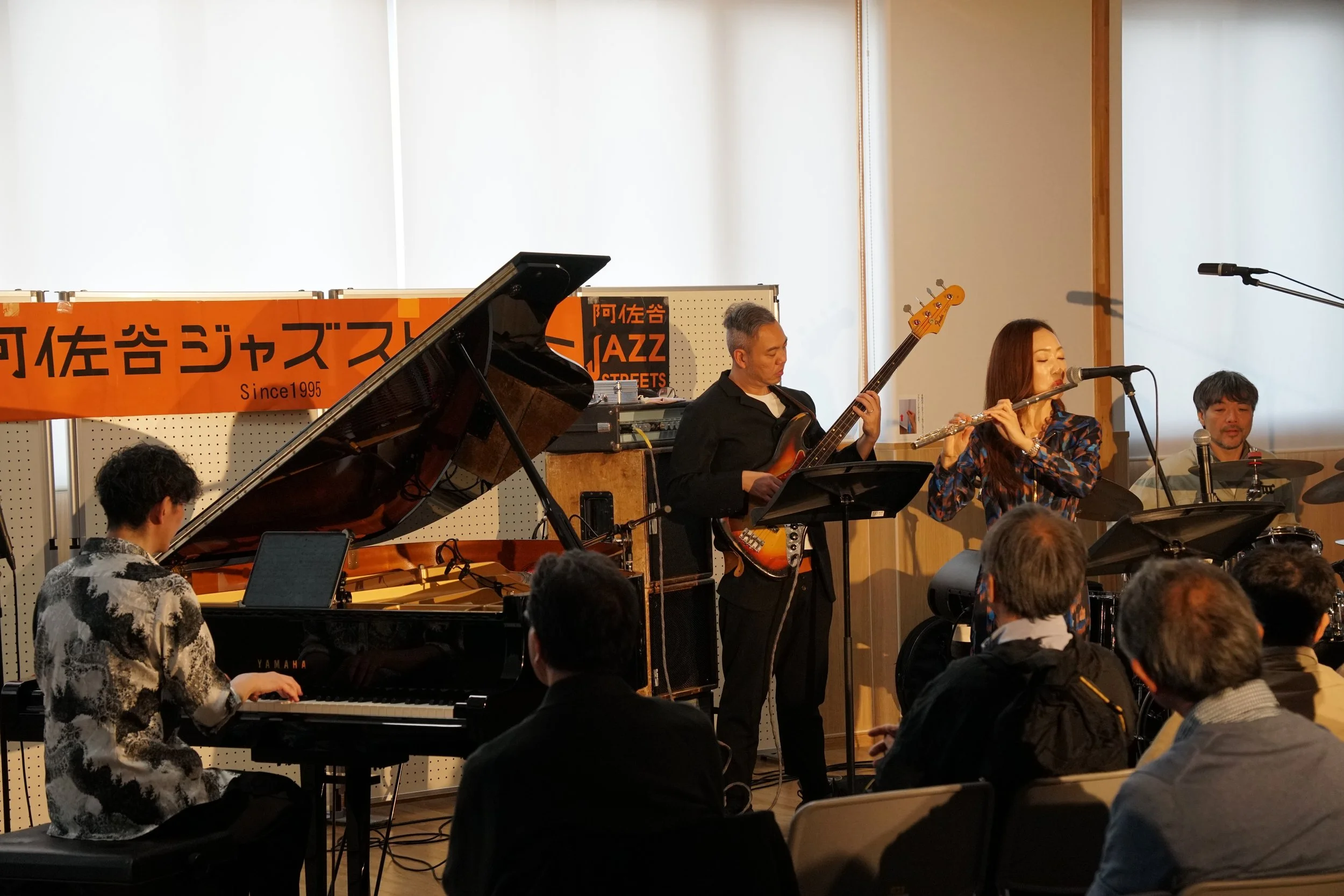
Makiyo Sakai Special Quartet
That’s not to say she always plays delicately, even on a standard like “Akatanbo.” She can dig into muscular breath power when she wants to. The final number, an original from Sakai, “Unleashed Swing,” was aptly named. The fresh blues changes charged ahead full-speed, giving her and the band plenty of room for wonderful solos. When the set ended, fans lined up to get her autograph on her most recent CD. It’s good they spread the shows out with time in between! It was a long line.
Already off to a great jazz start, I wandered toward the outdoor sessions to catch some of the open-air vibe. Again, there was too much to choose from. At the south exit of Asagaya Station, I caught The Asagaya Ten All Stars, a straight-ahead group playing classic updates on the Blue Note sound. The Fountain Square at the south exit of Asagaya Station was transformed into a jazz club. Named after a cool club on the north side of the station, the local collection of jazz musicians jumped into funky rhythms and unrestrained jamming. They never overdid it, though, and drawing on both jazz and the 60s jazz-funk merger, they played for a large crowd.
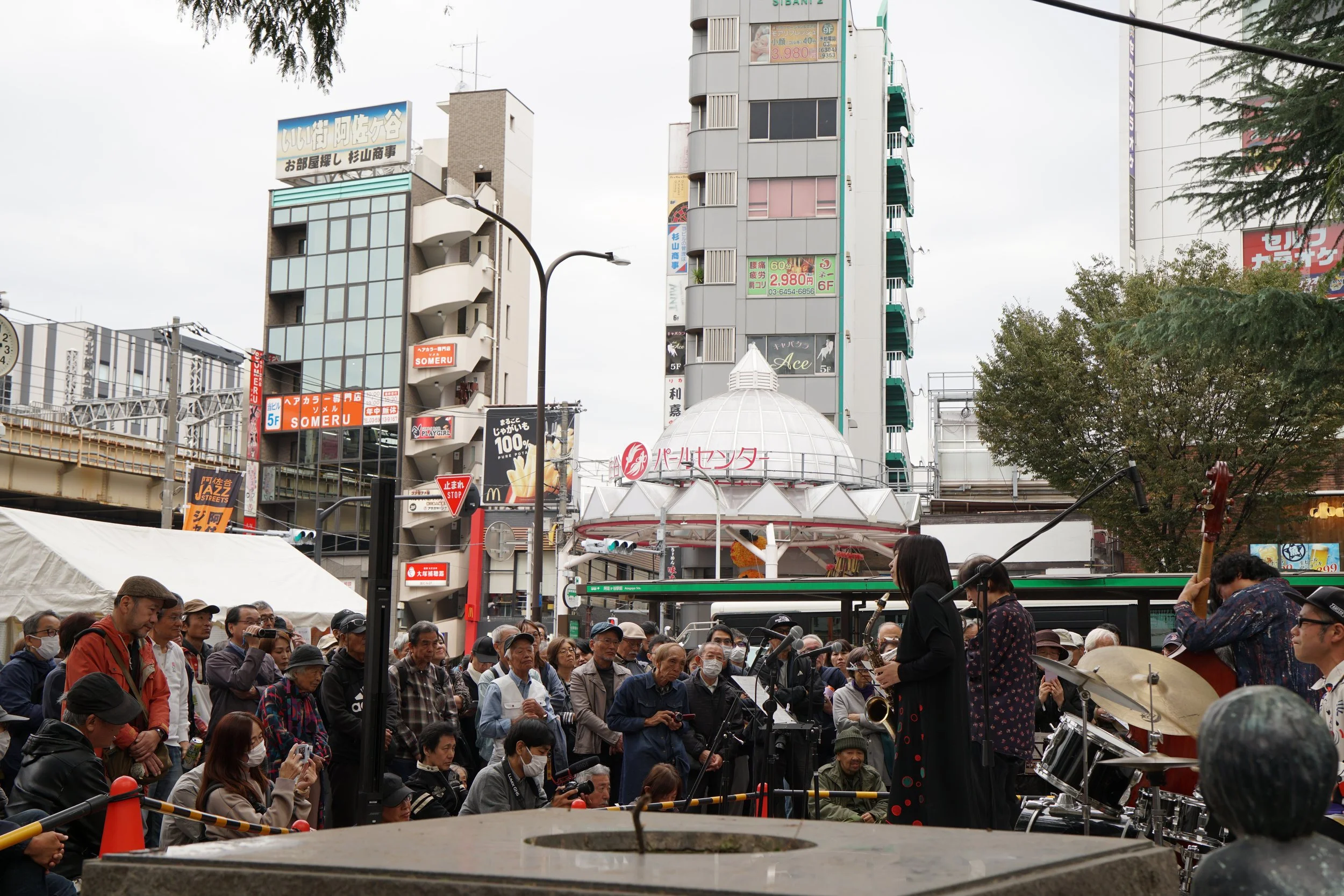
Asagaya Ten All Stars and Asagaya
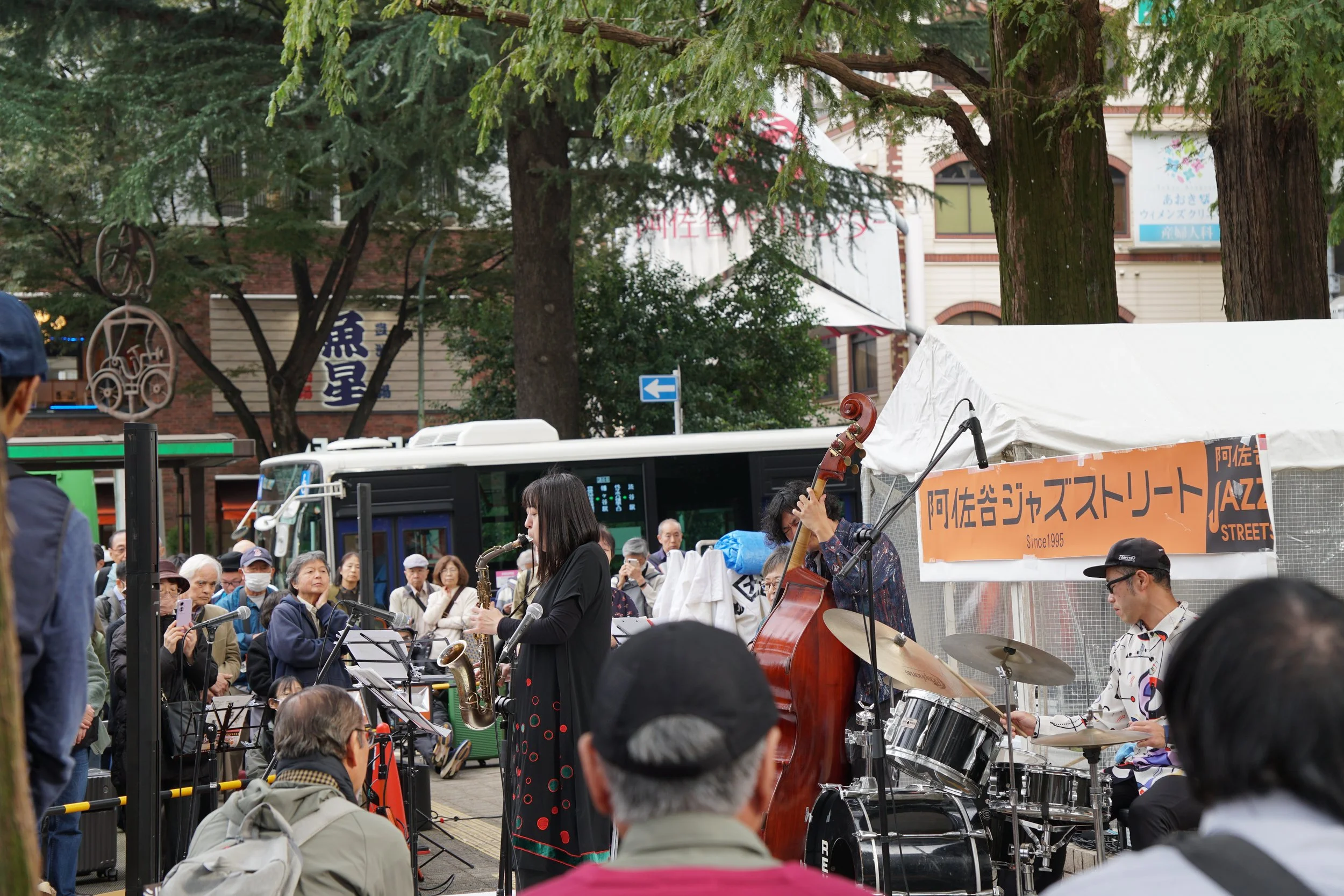
Asagaya Ten All Stars
They might have ended up there because it was free, but they stayed for the excellent performance. Whether delivering a Freddie Hubbard number or other classic 50s and 60s tunes, the Asagaya Ten All-Stars worked the classic front-line trumpet-and-sax style with a tight rhythm section. Their music fit the city that is usually rushed through, like a lesson in how to slow down and enjoy yourself. The trains rolling into and out of the station seemed to sync with the group's rhythm, and the group drew inspiration from the sprawling crowd and unique stage. You rarely hear live jazz while watching overhead trains come in and out.
From there, I wandered down the Asagaya Pearl Center Shopping Street, where kids raced around in Halloween costumes, trick-or-treating for small gifts from the shop owners along the street. It was a lively, amusing scene, with parents and kids in costume jostling with jazz fans and those there for the music. I wandered through the parade of princesses, batmen, witches, and multicolored monsters, only to stumble upon the marvelous Nicone Sax Quartet set up at a pedestrian crossing.
The all-women group played neatly harmonized arrangements of tunes like “Fly Me to the Moon,” “In the Mood,” and other classic jazz standards. Their nuanced dynamics and pristine tone gave each song, short and sweet as it was, real impact. The crowd smiled and applauded with each number. Next up was a guitar and vocal duo who played contemporary classics like “Time After Time” with lounge-cool vibes and lovely interplay between vocals and guitar. It’s hard to sound good on a noisy, busy street corner, especially with such a delicate touch, but the duo drew an appreciative crowd.
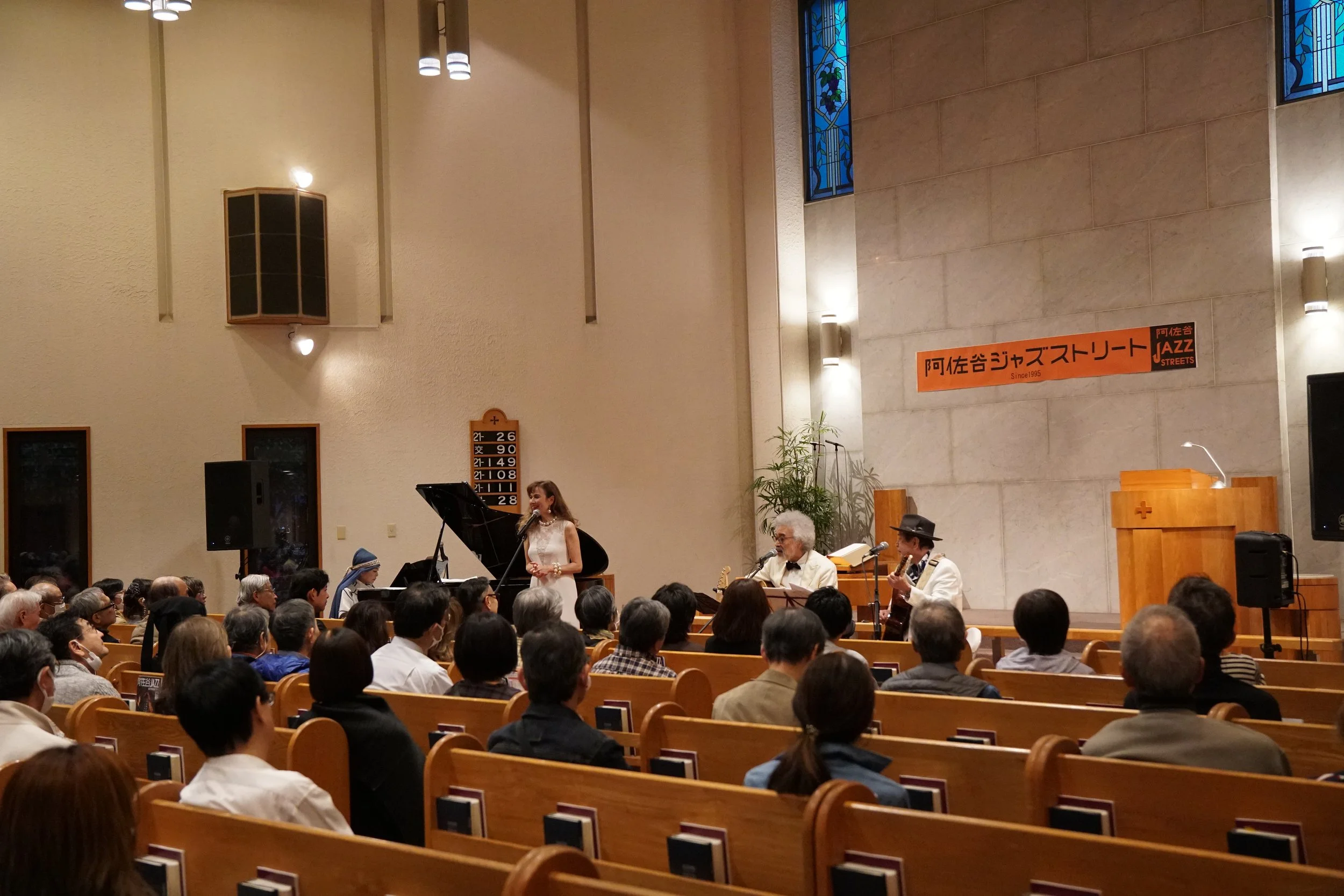
Uno, Naomi Grace, and Susumu Matsushita
Then it was off to church! Asagaya Church has long offered its sanctuary for Asagaya Jazz Streets performances. I caught the new Spanish guitar and piano duo UNO with jazz-pop singer Naomi Grace and Susumu Matsushita, a guitarist as famous for his manga and retro anime as for guitar. Blending Spanish flamenco with pop guitar and vocals, keeping it all grounded in a jazzy approach, they created a unique combination. Performing in a church gave it a kind of consecration that you rarely find. Jazz, after all, comes from unique musical traditions blended into ever-new combinations.
After seven straight hours of music, I headed home, a little worn out, but guilty at skipping the choice of music at 33 venues in and around Asagaya. The streets of Asagaya were still busy as I walked to the station.
The next morning, I got there early and followed the map, wandering streets from one “stage,” often no more than music stands, following a jazz parade and taking in all the street-side performers. By early afternoon, though, I wanted to sit down, and headed to the Suginami Daiichi Elementary School Gymnasium. This isn’t a jokey club title—it’s really a grade-school gym, complete with an overhead track, basketball goals, a school motto plaque, and a shiny wood floor. You have to take your shoes off as if you’re in school.
Everyone taking up all the chairs (a volunteer had to bring me over one more chair) got an education in how big bands can take a song from any genre and make it shine with high energy. The Tawoyame Orchestra, a 16-member band, plays with as much abandon and joy as any big band around, while keeping virtuosic attention to its tightly scripted and very dynamic b music. The all-female band has been playing together for 18 years, with a repertoire that spans post-war pop like “Jungle Boogie,” Kayo pops like “Blue Light Yokohama,” anime theme songs like “Mahotsukai Sari” (“Sally the Witch”), and oldies like “Save the Last Dance for Me.”
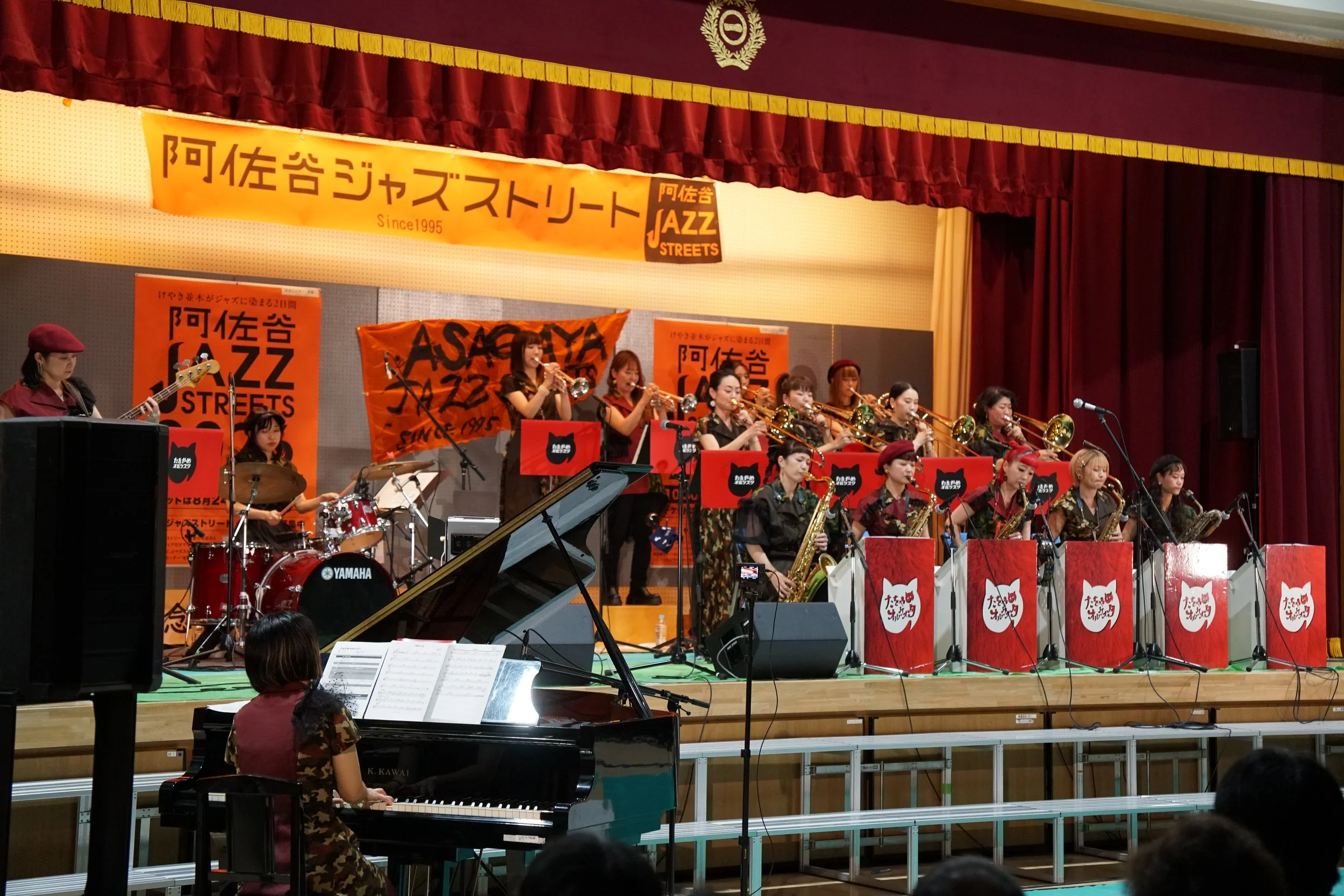
Tawoyame Orchestra from the left
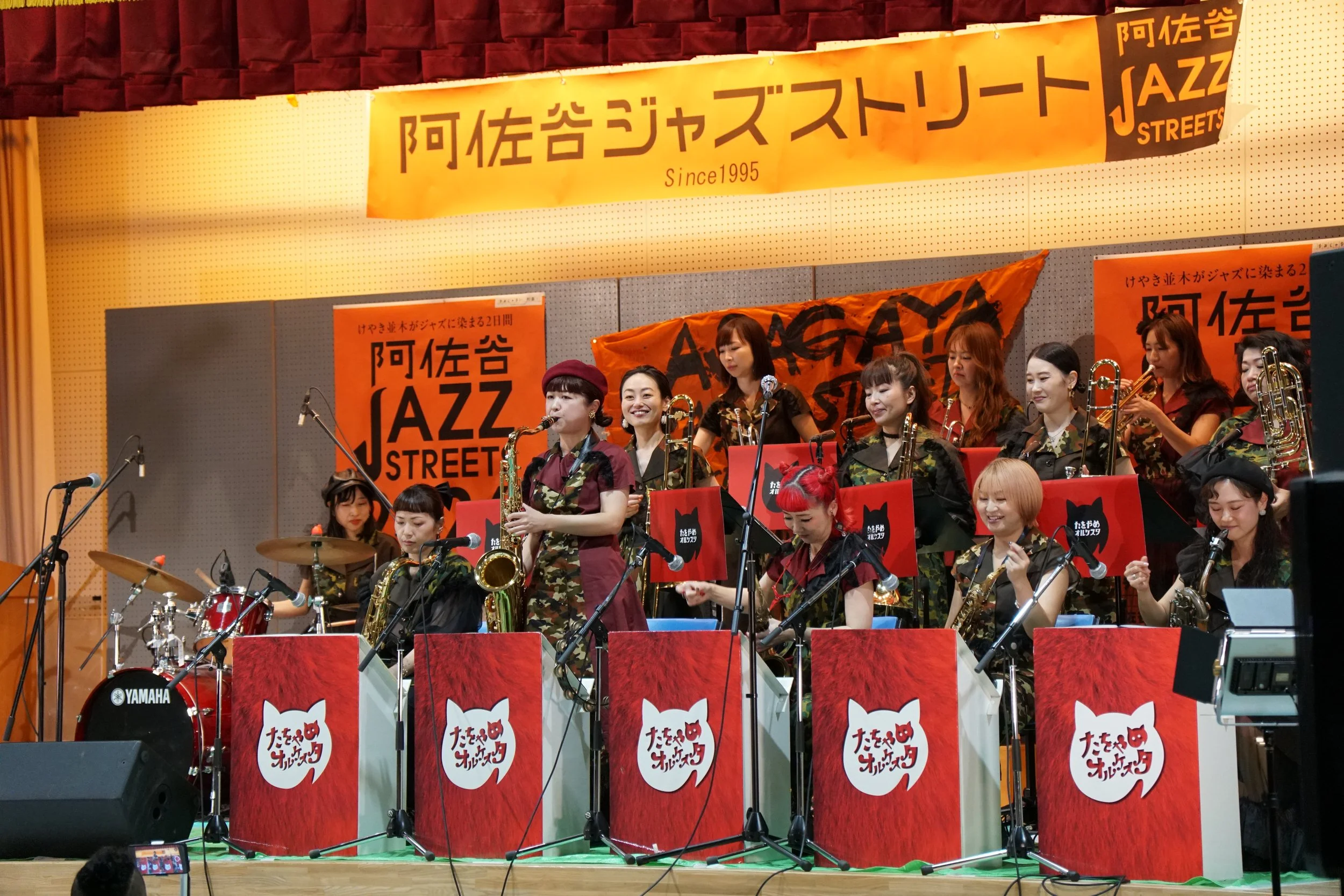
Tawoyame Orchestra from the right
All these very Japanese songs work perfectly with American big band arrangements. The band is perfectly practiced, each musician talented, and even their spontaneous whoops, yells, and shots were in harmony. After the show, the line to get a CD and autograph stretched halfway around the sports field from the gym to the front gate. They were a wonderful blend of influences, driven by the sheer energy the band members pumped into their eclectic music.
Not wanting to wait too long to talk with them, I took photos of the marvelous banners the elementary school students had made (see the accompanying article). I chatted with one teacher before heading for more music. I passed by the station on my way, where a college Dixieland band was belting out their own powerfully spirited take on music that was popular before their great-grandparents were born. “When the Saints Go Marching In” should play through the streets all the time, in my humble opinion! Their energy was infectious, and their understanding of the music was deeply respectful.
Working my way from elementary school past the college bands, I headed for more adult music and found just that at Asagaya St. Peter’s Church, a lovely chapel that seems designed for jazz. I snuck in with my journalist’s pass around disappointed jazz lovers being turned away at the door. It was far past being sold out. Sitting in the pews changes how you listen, more spiritual perhaps, more attentive and reflective compared to listening over drinks in a club. Erena Terakubo’s Quartet would sound great anywhere. Returning from her career and performing life in New York City, she joined up with a top-level rhythm section from Japan. Her straight-ahead, fast-tempo takes on classic jazz tunes, rearranged in her own thoughtful way, were exceptionally good.
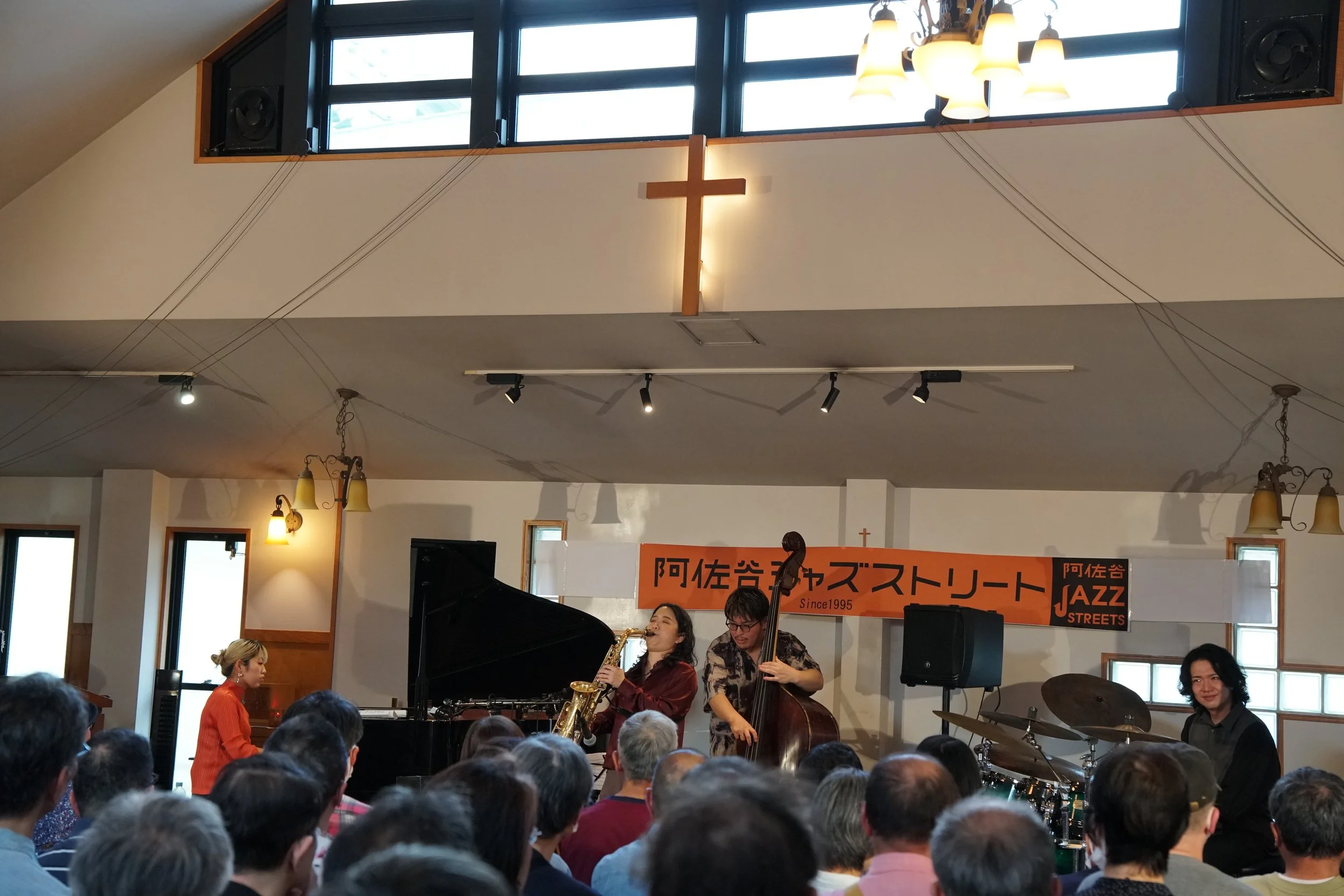
Erena Terakubo Quartet
“All the Things You Are” had a clever arrangement and a tempo that never slowed down. “Autumn in New York” was the most reflective tune, with a particularly great piano solo from Hatsune Hirakune. Coltrane’s “Mr. Day,” taken in the original, difficult key of F#, had amazing solos from everyone, with a tricky rhythm that pushed the quartet to play more powerfully. Terakubo’s long, nimble lines seemed to both tear at the air and hang there. Horace Silver’s “Peace” slowed down, letting the quartet work with a feeling of calm complexity. Notes fell like feathers, and the group’s firm tone was striking, leaving lots of space in the music. Terakubo really let loose on the finale, “Bye Bye Blackbird,” with more notes than you can follow and tight ensemble interplay that sounds easy in their hands but is, in fact, intricate and accomplished. The sold-out church (sounds odd, perhaps) was filled with fans, pleased to experience another Japanese jazz musician making it in the homeland of jazz, and yet still coming back to Japan.
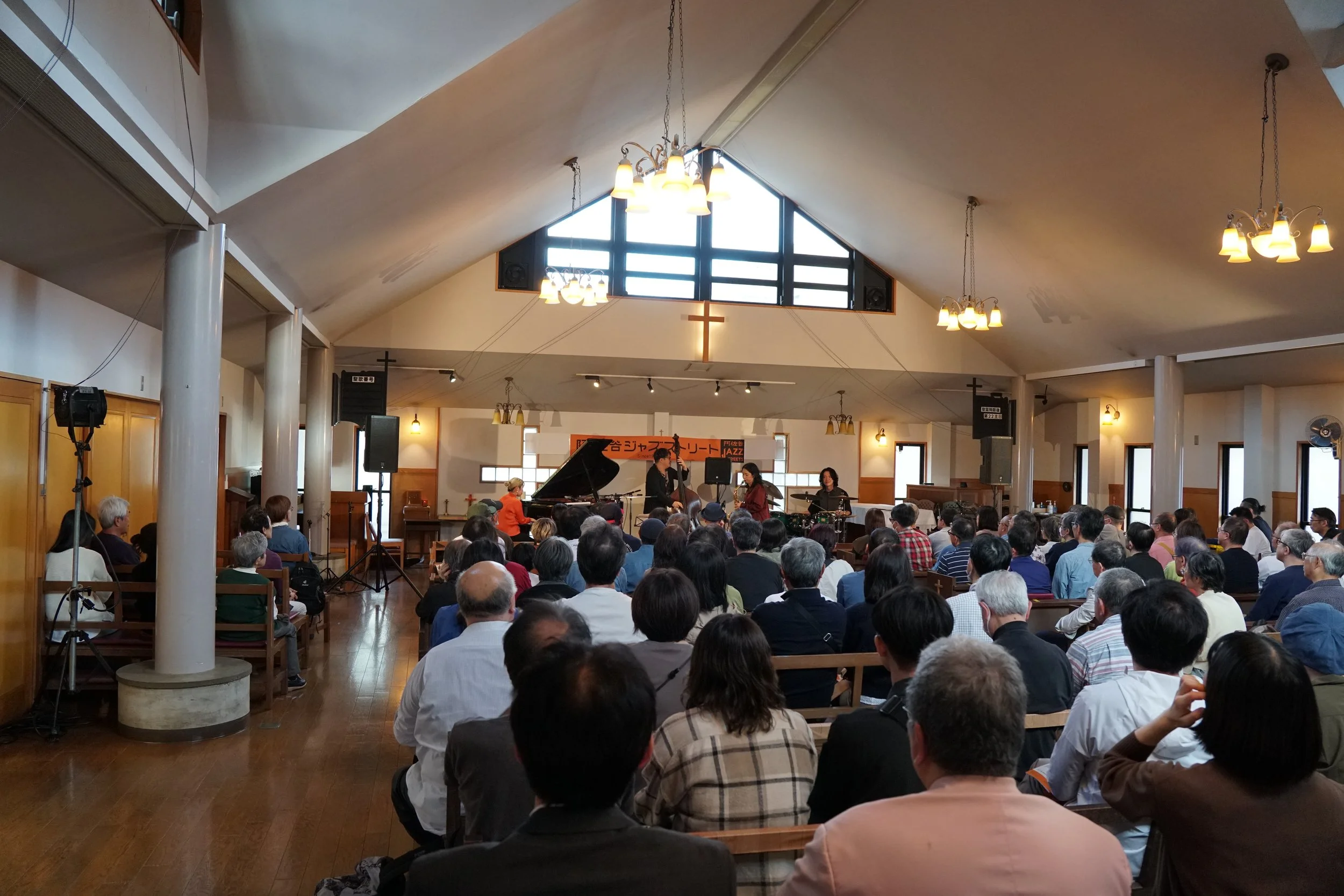
Erena Terakubo Quartet at Asagaya St. Peter’s Church
From church to church, I headed to Asagaya Church once again, and after a warm welcome from the minister, I got ready for a rousing set from trombonist Masahiko Kitahara of the famed Tokyo Ska Paradise Orchestra, along with saxophonist Monky from the Black Bottom Brass Band. Their musical and conversational interplay was a delight. The band was loose and ready to play mostly originals. Moving from straight urban jazz to cha-cha-cha to Spanish touches to funk, everything landed satisfyingly. Usually, such variety is just that, but the musicians laid out a driving yet relaxed style of music that also let everyone spread out for solos. It all worked, which is always the key point in jazz.
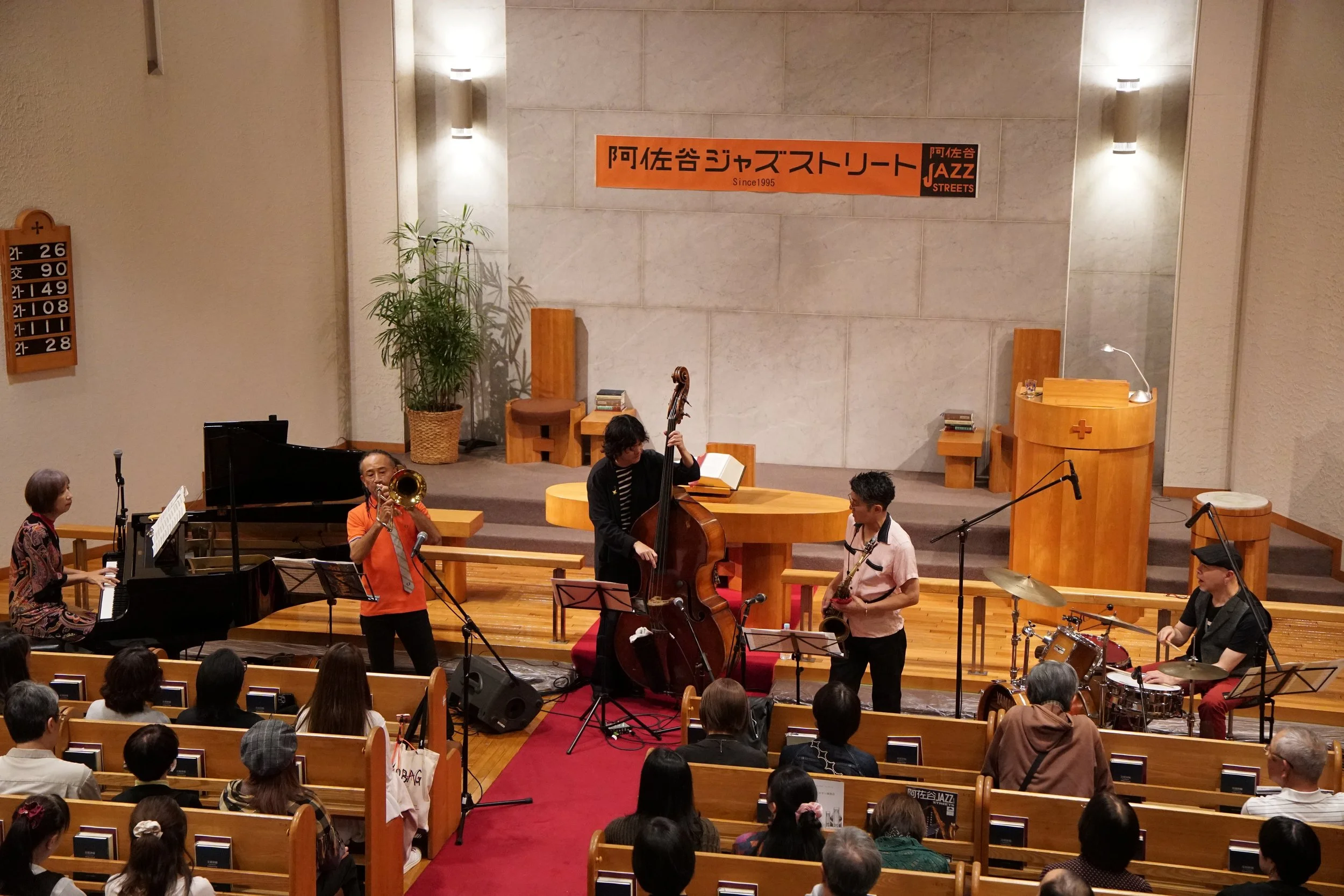
Masahiko Kitahara and Monky
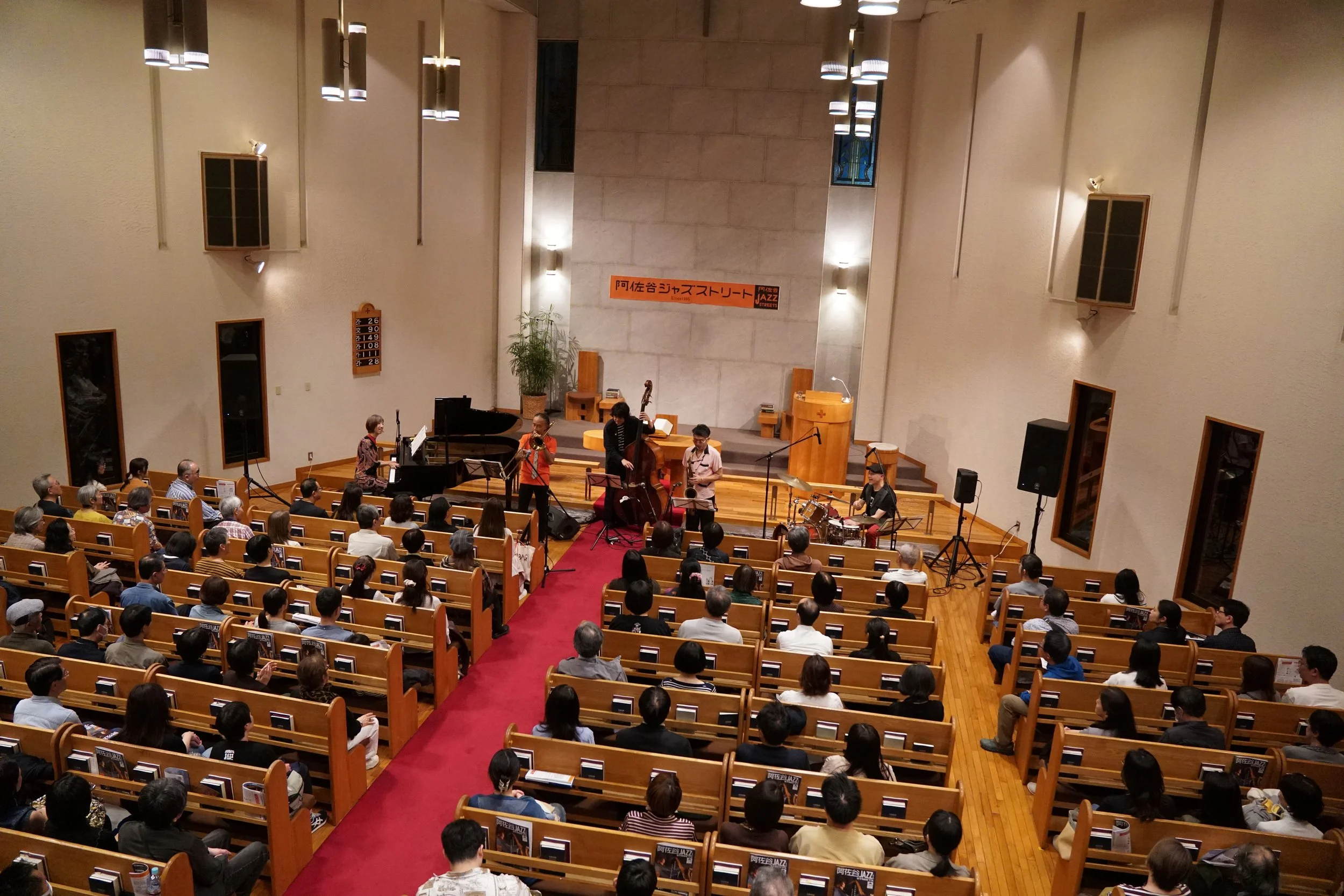
Masahiko Kitahara and Monky at Asagaya Church
What I like about the Asagaya Jazz Streets every year is also being immersed in the community, walking back and forth from venue to venue, and entering places I’d otherwise never go to. Taking jazz out of clubs and placing it in streets, churches, coffee shops, and public squares shows how powerful the music can be, independent of the space, but harmonizing with it, too. It’s also a way to create and build community, showing that a festival doesn’t have to be in a huge stadium or a faraway field, but right in the everyday neighborhood where people go every day.
With so many performers, I could have indulged in even more jazz, but it’s easy to get overwhelmed, too. Even to see only a small fraction of the 200 groups (an estimated 1,200 musicians) was a delight. I could probably write a longer article on what I missed. But jazz is in the moment, and while it would be very cool to cover everything, no one ever has, and no one ever can. But having that feeling of missing out is special in its own way, too. It leaves things open, which might be one of jazz’s secret powers. Missing so many events reminded me how vast the jazz scene is in Japan, and of what variety, virtuosity, and roots jazz has evolved even in a single neighborhood of western Tokyo.